How to Write a Referral Email (With Templates)
 By Nora Ellison
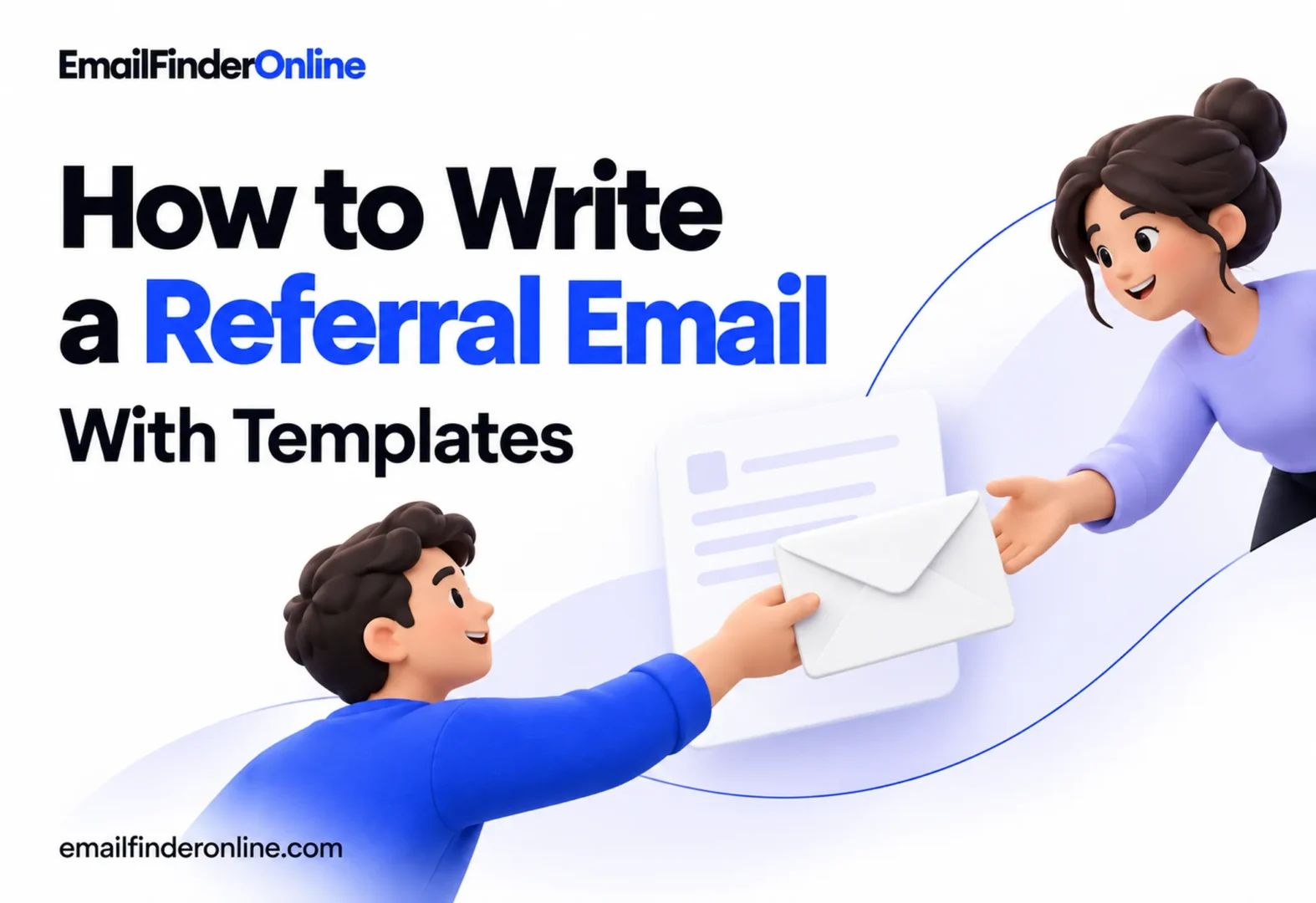
You know a happy customer could send you their next client, or a colleague could open a door you cannot open alone, but the ask feels awkward and the email never gets written. A referral email solves that in one of two ways: it asks someone who already trusts you to recommend you, or it uses a shared contact’s name to start a conversation with someone new. Either way, the email that works is short, specific about the request, easy to act on, and followed up once.
Below you will find how to write both kinds, when to send them, how to follow up, and templates and subject lines you can adapt.
The two kinds of referral email
Before writing, be clear about which one you are sending. They have different readers and different jobs.
| Asking for a referral | Mentioning a referral | |
|---|---|---|
| Who receives it | A customer, client or contact who knows your work | Someone new, suggested by a person you both know |
| What you want | Names, an introduction, or a share of your offer | A reply, a call or a meeting |
| What makes it work | Good timing and a very easy next step | The mutual connection’s name, early and accurate |
| Main risk | Asking too soon or too vaguely | Overstating how well the referrer knows you |
How to ask customers for a referral
Step 1: Pick the moment
Ask right after the customer has felt the value of what you did: a project delivered, a problem solved, a positive review or a thank-you note. A referral request that arrives at that moment reads as a natural next step. One sent in the middle of an open support issue reads as tone-deaf.
Step 2: Choose who to ask
Not every customer is the right person. Start with people who have said something positive in writing, who have stayed with you for a while, or who work in a network full of the kind of clients you want. A short, personal list beats a blast to everyone.
Step 3: Make the request specific
“If you know anyone who might need us, let me know” is easy to agree with and easy to forget. Describe the person you can help: their role, their situation, the problem they have. Specific requests help the reader picture a real name.
Step 4: Make it easy to act
Remove every step you can. Offer a two-line description they can paste into their own email, a link they can share, or an offer to write the introduction for them to approve. The less writing you ask of them, the more likely they are to do it.
Step 5: Decide on an incentive, and handle it properly
Some businesses reward referrals with credit, discounts or gifts; others rely on goodwill. Mailchimp’s guide to referral emails recommends that when you offer a referral incentive, you make the mutual benefit for the referrer and the friend clear (Mailchimp). Rewards also carry a legal angle in the US. The FTC’s CAN-SPAM guidance says a seller that offers money, coupons or discounts in exchange for forwarding a message may be responsible for compliance, and a seller that pays or gives a benefit for any form of referral is likely to have obligations under the law (FTC). In practice, emails sent as part of a rewarded program should include your physical mailing address and an easy way to unsubscribe, just like your other marketing email.
How to introduce yourself through a mutual connection
Step 1: Get permission to use the name
Before you write “Maria suggested I reach out,” check that Maria is happy to be named and that she remembers suggesting it. A referrer who is surprised by your email can undo the trust you were counting on.
Step 2: Ask for a warm introduction when you can
A warm introduction, where the mutual connection emails both of you together, usually lands better than a message from you alone. Make it easy: send the referrer a short note they can forward, covering who you are, why the contact might care and what you are asking for.
Step 3: Find and check the right address
If you are writing directly, make sure you have the right person and a working address. For the research itself, see our articles on tracking down a person’s email address and on identifying decision makers inside a company. Before sending, verify the email address so your first impression does not bounce.
Step 4: Put the name up front
Mention the mutual connection in the subject line and the first sentence. That one detail is what separates your email from every other message from a stranger. Then say in one or two sentences why the referrer thought you should talk.
Step 5: Ask for something small
A short call, a quick answer to one question, or permission to send a short overview are easier to accept than “a meeting to discuss your needs.” You can ask for more once the conversation has started.
How to write a follow-up email after a referral
People mean to reply and then forget. One polite follow-up is normal; several in a row are not.
- Timing: wait about a week before the first follow-up. If there is still no reply, one more note a couple of weeks later is enough.
- Content: add something new, such as a relevant example or a simpler ask, rather than writing “just bumping this.”
- Tone: make it easy to say no. “If now is not a good time, no problem” lowers pressure and often gets a reply.
- Close the loop: whatever happens, thank the person who referred you and tell them how it went. Referrers who hear back are more likely to refer again.
For more on structuring follow-ups in outbound sequences, see our guide to cold email outreach.
Referral email templates
Swap the brackets for real details and trim anything that does not fit your voice.
Template 1: Asking a happy customer for a referral
Subject: A quick favor, [First name]?
Hi [First name],
Thanks again for your kind words about [project or result]. It was a pleasure working on it with you.
We are taking on a few new clients in [month or quarter], and the people we usually help are [role] at [type of company] who are dealing with [problem]. If someone like that comes to mind, would you be open to introducing us?
To make it easy, here is a short note you can forward: “[Two-sentence description of what you do and for whom].”
No pressure at all, and thank you either way.
[Your name]
Template 2: Rewarded referral program
Subject: Share [product] and you both get [reward]
Hi [First name],
If you know someone who would get value from [product], you can now send them your personal link: [link].
When they [sign up or make a first purchase], they get [reward for friend] and you get [reward for referrer].
[Share my link]
[Company name], [postal address]. [Unsubscribe]
Template 3: Introducing yourself through a mutual connection
Subject: [Mutual connection] suggested we talk
Hi [First name],
[Mutual connection] mentioned you are working on [project or challenge] and thought we should connect. I [one sentence about what you do and a relevant result].
Would you be open to a short call next week to see whether it is worth a longer conversation? If someone else on your team handles this, I would be grateful for a pointer.
Thanks,
[Your name]
Template 4: Following up
Subject: Re: [Mutual connection] suggested we talk
Hi [First name],
Following up on my note from last week. I put together [a short example, a relevant link or a one-page summary] in case it is useful: [link].
If the timing is not right, no problem. Just let me know and I will not keep nudging.
[Your name]
Template 5: Thanking the referrer
Subject: Thank you for the introduction
Hi [First name],
Thanks for connecting me with [contact name]. We spoke on [day] and [brief outcome]. I really appreciate you thinking of us.
[Your name]
Subject lines for referral emails
| Situation | Subject line ideas |
|---|---|
| Asking a customer | “A quick favor, [First name]?”, “Know someone who needs [result]?” |
| Rewarded program | “Give [reward], get [reward]”, “Your referral link is ready” |
| Mutual connection | “[Name] suggested I reach out”, “Introduction via [Name]” |
| Follow-up | “Re: [original subject]”, “One more idea for [their company]” |
| Thank-you | “Thank you for the introduction”, “Update on your referral” |
Keep the subject honest. The FTC guidance also says the subject line has to match what the email is really about, so a referral ask dressed up as an invoice or a personal note from a friend is off limits.
Mistakes to avoid
- Asking everyone at once. A mass referral request sent to the whole list feels impersonal and gets ignored.
- Being vague about who you want. If the reader cannot picture a name, they will not send one.
- Name-dropping without permission. Using a mutual connection’s name they did not approve can damage two relationships.
- Following up too often. One or two follow-ups are enough. After that, let it go.
- Forgetting the thank-you. A referrer who never hears what happened is unlikely to help twice.
For a broader look at earning these introductions, HubSpot’s guide on how to ask for referrals collects further examples.
FAQ
What should a referral email include?
A clear reason you are writing, the name of the mutual connection or the moment that prompted the request, a specific description of who or what you are asking for, an easy next step and a thank-you. Keep it brief enough for a phone screen.
When is the right time to ask a customer for a referral?
Shortly after they have seen a result or said something positive, such as after a project wraps up, a goal is reached or they leave a good review. Avoid asking while a problem is still open.
Should I mention the referrer in the subject line?
Yes, when they have agreed to it. A familiar name in the subject line tells the recipient why they should open your email instead of treating it as another cold message.
How many times should I follow up on a referral email?
Once or twice is usually enough. Space the follow-ups out, add something useful each time, and stop after the second if there is no reply.
Do referral emails need an unsubscribe link?
A personal one-to-one introduction is different from a marketing campaign, but referral program emails that promote your product, especially rewarded ones, should follow the same rules as your other commercial email, including a mailing address and a simple unsubscribe route.
Wrapping up
A good referral email is specific, easy to act on and honest about the relationship behind it. Ask customers at the moment they feel the value, use a mutual connection’s name only with permission, put the request in one or two sentences, follow up once or twice, and always thank the person who opened the door. If you are researching contacts for these introductions, you can check Email Finder Online pricing.