What Are Email Marketing Objectives? Six Goals, Explained
 By Nora Ellison
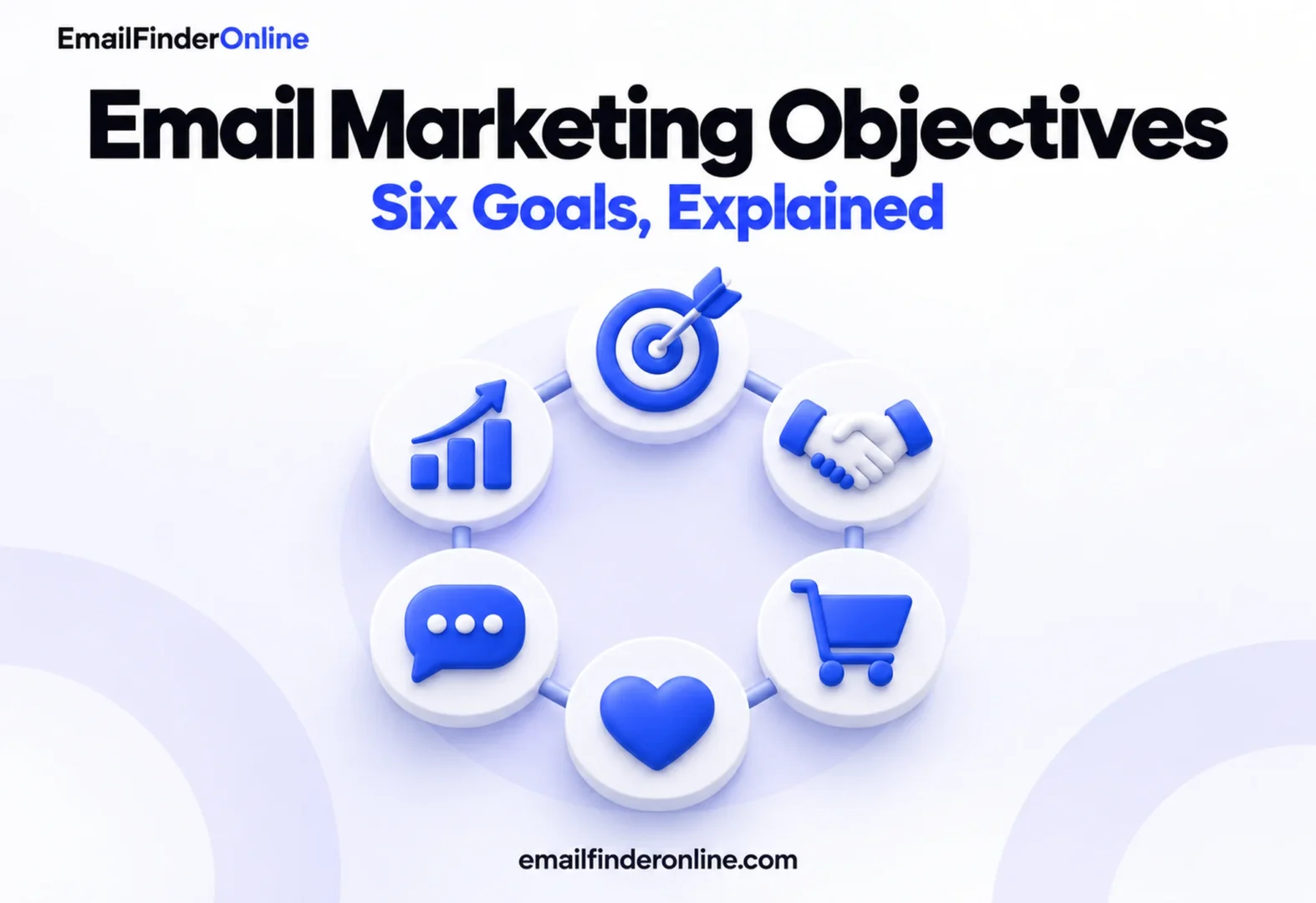
The report lands after every send, and the team stares at opens and clicks without agreeing on whether the email worked. That is a sign the campaign never had a stated purpose. Email marketing objectives are the business results you want your emails to produce: awareness, engagement, lead nurturing, conversion, retention and reactivation. Pick one per campaign, write it as a SMART goal, and track the one metric that reflects it.
This explainer walks through each objective in plain terms, shows a goal template you can copy, and points out where common metrics mislead, so your next report answers a real question.
Objectives, goals and tactics are not the same thing
People use these three words as if they were interchangeable, and that is where reporting starts to drift. An objective is the direction. A goal is a measurable target on the way there. A tactic is the specific email or sequence you send to hit that target.
| Level | What it describes | Example |
|---|---|---|
| Objective | The business result email should support | Keep more customers after their first purchase |
| Goal | A measurable target with a deadline | Lift the second-order share among new buyers by the end of the quarter |
| Tactic | The email work that moves the number | A three-part onboarding series with product tips |
| Metric | The number you read to judge progress | Share of new buyers who place a second order within the window |
When a campaign is planned from the top of this table down, the metric is chosen before the email is written. When it is planned from the bottom up, the metric is whatever the dashboard happens to show, and open rate tends to win by default.
The six email marketing objectives at a glance
Every email program uses some mix of these six. The table pairs each with the kind of email that usually serves it and the number that tells you whether it is working.
| Objective | What you want to happen | Typical emails | Primary metric | Supporting signals |
|---|---|---|---|---|
| Awareness | More of the right people know you exist | Welcome email, newsletter, content roundups | Growth in engaged subscribers | Forwards, replies, new signups from shared links |
| Engagement | Readers interact with what you send | Newsletter, tips series, surveys | Click rate | Replies, click-to-open rate, time on page |
| Lead nurturing | Prospects move closer to a buying decision | Drip sequence, case study series, webinar invites | Leads that reach sales-ready status | Clicks on pricing, demo or comparison pages |
| Conversion | Subscribers buy, book or sign up | Offers, launch emails, cart and trial reminders | Conversion rate per email | Revenue per recipient, click rate |
| Retention | Customers stay, renew and buy again | Onboarding, usage tips, renewal notices | Repeat purchase or renewal rate | Unsubscribe rate, support tickets |
| Reactivation | Quiet contacts return or leave cleanly | Win-back and “still interested?” emails | Share of inactive contacts who click again | Removals after the sunset date |
Objective 1: Build awareness
Awareness email is about reach among people who fit your audience, not raw list size. A welcome email that explains what subscribers will get, a newsletter worth forwarding, and roundups that a reader can share with a colleague all serve it.
The trap is counting every new address as progress. A list padded with mistyped or abandoned addresses grows on paper while delivery suffers. If you build lists for outbound work, our article on building a B2B email list explains how to keep growth tied to fit.
Metric to watch: growth in subscribers who click or reply within their first few emails, rather than total signups.
Objective 2: Drive engagement
Engagement means readers do something with your email: click a link, answer a question, take a survey. It matters because a reader who never clicks is unlikely to buy later, and a list full of silent readers is hard to grow from.
Clicks are the sturdier signal here. Opens are tracked by a hidden image, and Apple’s Mail Privacy Protection downloads remote content in the background by default, whether or not the person reads the message (Apple). That makes open counts unreliable for anyone with a large share of Apple Mail readers.
Metric to watch: click rate on the links you care about, plus replies when you ask a direct question.
Objective 3: Nurture leads
Lead nurturing is for people who are interested but not ready. A sequence of useful emails, each one answering a question a buyer has at that stage, moves them toward a decision without a hard sell in every message.
For B2B teams, nurturing often starts after a first conversation from outbound prospecting. The planning in our cold email outreach guide covers that first touch; nurturing is what keeps the thread alive once someone has said “not yet.”
Metric to watch: the share of nurtured leads that reach the stage your sales team calls ready, along with clicks on high-intent pages such as pricing or demo requests.
Objective 4: Convert subscribers into customers
Conversion email asks for a specific action: buy, start a trial, book a call, register. Product launches, time-limited offers and reminders for abandoned carts or unused trials all belong here.
Conversions happen on your site, not in the inbox, so you need tracking that connects the visit back to the email. Google’s Analytics help pages recommend always adding utm_source, utm_medium and utm_campaign to campaign links, with utm_medium set to a value such as email (Google Analytics). Without those tags, sales from email often show up as direct traffic and the campaign looks weaker than it was.
Metric to watch: conversion rate per email (conversions divided by delivered emails), with revenue per recipient for stores.
Objective 5: Retain and grow existing customers
Customers have already agreed to hear from you, which gives customer retention email a head start. It teaches people to get value from what they bought, reminds them before renewals, and suggests the next purchase that makes sense.
The warning sign for this objective is a rising unsubscribe rate among customers. It usually means the emails feel like ads rather than help.
Metric to watch: repeat purchase rate or renewal rate among customers who receive the emails, compared with those who do not.
Objective 6: Reactivate inactive contacts
Every list has people who stopped reading. A win-back sequence gives them a reason to return, a simple way to choose fewer emails, and a clear end date after which you stop mailing them.
Removing people who never respond can feel like losing ground, but old, silent addresses are where hard bounces and spam traps tend to collect. Our email bounce prevention guide explains why stale addresses hurt delivery for the rest of the list.
Metric to watch: the share of inactive contacts who click again during the sequence, and how many you remove at the end.
How to turn an objective into a SMART goal
An objective tells you where to go. A SMART goal tells you how far and by when. SMART stands for Specific, Measurable, Achievable, Relevant and Time-bound, and each letter filters out a common weakness in email goals.
- Specific: name the campaign or segment. “All emails” is too broad to act on.
- Measurable: choose one metric from the table above and define how you calculate it.
- Achievable: pull your own baseline from recent sends before you set a target. Your history is a better guide than someone else’s average.
- Relevant: connect the goal to the objective and, through it, to a business result someone outside marketing cares about.
- Time-bound: set an end date and a review date.
Copy this template and fill in the brackets:
By [end date], increase [metric] for [campaign or segment] from [current baseline] to [target], to support [objective]. We will review progress on [review date].
Two filled-in shapes, with your own numbers in place of the brackets:
- Engagement: By [end of quarter], raise the click rate on the monthly newsletter from [baseline] to [target], to show that readers find the content useful.
- Reactivation: By [date], bring back [target share] of contacts with no clicks in [period], then remove the rest from regular sends.
Reading the numbers: what each metric can and cannot tell you
A goal is only as good as the metric behind it. A few cautions apply to almost every program.
Open rate is now a rough signal. Because of the Apple behavior described above, opens can rise without anyone reading. Mailchimp notes on its own benchmark page that open rate accuracy may be affected by Apple’s privacy changes (Mailchimp). Use opens to spot sudden drops, such as a delivery problem, not to prove success.
Benchmarks are context, not targets. Mailchimp’s benchmark table lists an average open rate of 35.63%, an average click rate of 2.62% and an unsubscribe rate of 0.22% across all its users, based on data as of December 2023 (Mailchimp). Your audience, list source and email type can put you far from those figures in either direction, which is why the SMART template starts from your baseline.
Delivery comes first. Every metric is calculated on emails that arrived. If a share of your addresses bounce, your click and conversion rates are computed on a shrinking, distorted base. Checking each address ahead of a send keeps the numbers honest, and the checks are laid out in our walkthrough for verifying an email address.
Attribution needs a decision. Decide in advance how long after a click a purchase still counts toward the email, and keep that window the same across campaigns so results are comparable.
Common mistakes when setting email objectives
- Chasing several objectives in one email. A message that tries to inform, sell and win back at once usually does none of them well. Give each email one job.
- Using the same metric for everything. Click rate suits engagement; it says little about retention. Match the metric to the objective.
- Setting targets from industry averages. Start from your own recent results and raise the bar from there.
- Ignoring list health. Bounces and complaints drag every rate down. Treat list quality as part of every goal.
- Never revisiting the goal. Review on the date you set, keep what worked, and rewrite goals that turned out to be the wrong measure.
FAQ
How does an email marketing objective differ from a KPI?
The objective is the result you are after, such as keeping more customers. The KPI is the number you use to judge progress toward it, such as renewal rate. One objective can have a primary KPI and a few supporting signals.
How many objectives should a single campaign have?
One. A campaign can support the wider program in several ways, but each email or sequence should be planned and judged against a single objective so the result is clear.
Are open rates still useful?
They are useful as a warning light. A sudden fall in opens can point to a delivery or authentication problem. As proof that people read your email, they are weak, because some mail apps load tracking images automatically.
What objectives should a small business start with?
Many small businesses start with engagement and conversion, because a small list that clicks and buys is worth more than a large one that ignores you. Add retention once you have repeat customers to serve.
How often should email goals be reviewed?
Review on the date written into each goal, and look at trends monthly. Quarterly is a common rhythm for resetting targets, since a single send is too small a sample to change direction on.
Putting it together
Email marketing objectives give every send a reason to exist. Choose one of the six for each campaign, turn it into a SMART goal built on your own baseline, track the metric that matches it, and treat opens as a hint rather than a verdict. Clean addresses underpin every number you report, so keep list quality on the checklist. If list building is part of your plan, you can see Email Finder Online pricing.